
Emotions Meet AI: Tech-driven Leadership: Exploring the Synergy between Emotional Intelligence and Technology
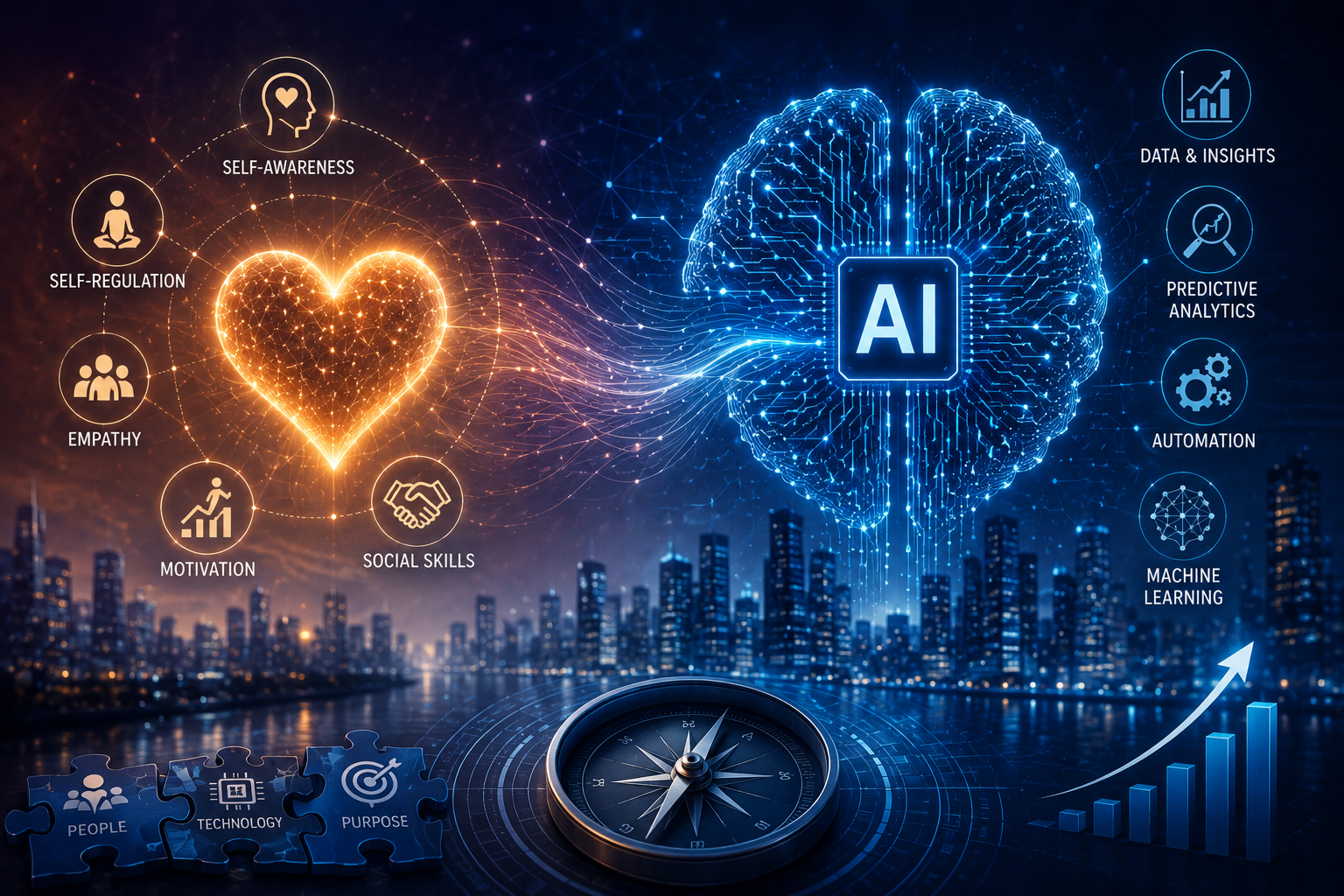
Emotional intelligence (EI) and artificial intelligence (AI) are two ascendant concepts in the constantly changing business environment that rewire the fundamental notions of leadership. Emotional self and social awareness – the ability to recognize and systematically regulate one's emotions and those of others – are viewed as peremptory for managers (Charles, 2023). At the same time, AI impacts industries by improving operational efficiency and considering information in various processes. Combining these two factors generates a synergy that enriches the development of leaders and makes them more proficient in crucial areas such as creative problem-solving and understanding others.
The Role of Emotional Intelligence in Leadership
Emotional intelligence (EI), for that matter, is the foundation of inspirational leadership as it is the cornerstone for problem-solving in human emotions. High EI is correlated with creating solid relations, promoting a positive organizational climate, and increasing work motivation and performance (Charles, 2023). Having explored the notion of EI, it is evident that its elements, including self-awareness, self-regulation, motivation, empathy, and skills in interpersonal interactions, are crucial for leadership.
Firstly, self-awareness is essential because it helps leaders manage their behavior, emotions, and thought processes to enhance their character. Self-regulation assists leaders in dealing with how they feel and handle emotions, especially during difficult circumstances, Characteristic (Charles, 2023). Motivation is the zeal that compels leaders to tackle goals and challenges with enthusiasm and determination and the same passion that followers are also motivated to display.
Compassion, a quality that involves identification with another person, helps one connect with subordinates, and once that bond is formed, the followers cannot betray the leader (Charles, 2023). Abstract Successful management of social processes, sharing ideas, anger management, and other elements of interpersonal interactions are essential for team building and establishing good interpersonal rapport.
Integrating EI with leadership behaviors enables leaders to establish trust and develop positive relationships, improve decision-making, and spur creativity. Self-awareness is one of the innovative frames that can help leaders make work teams cooperative and effective. It provides a balance between an analytical and a practical approach to decision-making. Comprehensive data and people's emotions and needs are considered, respectively. Dr. Charles states that managed risk and open transparency are valued and can foster psychological safety, encouraging team behaviors such as self-organized learning, inquiry, and risk-taking (Charles, 2023). To sum it up, EI is not an added vantage but a key imperative for any leader in the contemporary world who seeks to build strong organizations capable of competing, surviving, and excelling in the rapidly changing global environment.
The Impact of AI on Leadership
AI technology has dramatically impacted leadership by offering systems that improve decisions and efficiency while providing never-seen capabilities. By deploying tools like predictive analytics, natural language processing, and machine learning, AI empowers managers to work through large amounts of data, integrate automation in various tasks, and personalized employee experience. These advanced tools make leaders concentrate more on critical activities and relationships, improving organizational efficiency. In addition, AI helps to define patterns, predict outcomes, and offer suggestions; in turn, leaders utilize these insights to sustain and advance their businesses. When applied, AI increases the effectiveness and efficiency of resource management, work processes, and the speed of adaptation to changes in the market environment. Also, AI makes it easier to identify employees' potential and how these could be developed to create better engagement and improved productivity (Charles, 2023). Therefore, AI enhances the operational elements of leadership and provides leaders with tools to build a less rigid, more flexible, and effective organizational environment.
The Synergy between Emotional Intelligence and AI
Integrating EI and AI into leadership creates leadership forms that use human and artificial intelligence's strengths. Overall, this potentiation enhances various aspects of leadership, including decision-making, inspirational motivation, and creative solutions to challenges. AI provides specific details in the decision-making process, while EI centers on efficient decision-making depending on the outcomes' impact on people. For instance, such technologies can discover employees' actions, schedules, and even fatigue. Managers can then solve such problems by emphasizing staff involvement and turnover (Charles, 2023). Moreover, the problem-solving ability that results from integrating AI with EI's creative and empathetic personality fosters a suitable environment for finding solutions. Therefore, this radical approach embraces the technical aspect and people's needs to improve the Suitability of the leadership style in the current business world.
Case Study: Transforming Leadership with EI and AI
The case of Dr. Sabine Charles is a fine example of the workings of emotional intelligence (EI) and artificial intelligence (AI) in leadership. Dr. Charles is an international motivational speaker and the CEO of Charles Financial Strategies & TAPA Institute. She has incorporated AI-related tools in her practice as CEO, where she provides business leadership (Charles, 2023). Even in her professional working style, she has proved that emotional intelligence is essential to positive organizational culture and policy.
Dr. Charles is famous for her straightforward explanation of complicated issues and persuasive ideas. She infuses the business sense with snippets of her own life, leveraging the fun of a game to foster strategic thinking and a framing of critical issues. During her presentations, she stresses the importance of incorporating EI while adapting to digital transformation and using AI to drive business advantage.
Specifically, within the context of practice, Dr. Charles employs predictive analytics that applies artificial intelligence to predict the future trends of the markets and make prudent decisions that arise from such determinations (Charles, 2023). Automating regular processes by using machine learning algorithms also benefits conventional work execution and relieves her and her team from attending to higher-valued tasks that require creative inputs. In addition, information and communication technologies such as natural language processing enhance ways of working among employees to achieve organizational strategies.
This view can be attributed to Dr. Charles realizing that integration of EI should maintain focus on the human aspect of the material. In particular, she focuses on the relevance of the valued social competencies that include empathy, self-awareness, and interpersonal skills as a leader. Thus, she can build a cohesive working atmosphere wherein the counterparts develop the appropriate emotional states (Charles, 2023). The symbiotic relationship between Emotional Intelligence (EI) and Artificial Intelligence (AI) can help Dr. Charles steer her organization through the challenges of the contemporary business environment, foster innovation to sustain the competitive advantage, and, at the same time, support her workers' Psychological Ownership.
Conclusion
Combining EI and AI is now an emerging phenomenon that can change the face of leadership in today's society. These two mega trends are synergistic, and when introduced by leaders into an organization, the decision-making processes are improved, innovation is promoted, and work is organized in such a manner that supports teamwork. “Team-worksonnel”, as Dr. Sabine Charles proves, applying both concepts of EI and AI can create a sophisticated system of leadership that can successfully manage both factors, technical and human. Such integration opens the path to a thoroughly sustainable and adaptable progression to existing leadership, making the leaders competent in interacting with the digital world.
References
Charles, S. (2023). Leadership MEQ integrating Mindset, Emotional Intelligence, and Leadership Qualities: inspiring professional excellence Paperback. https://www.drsabinecharles.com